
Bitcoin Holds Steady as Iran Conflict Shakes Global Markets
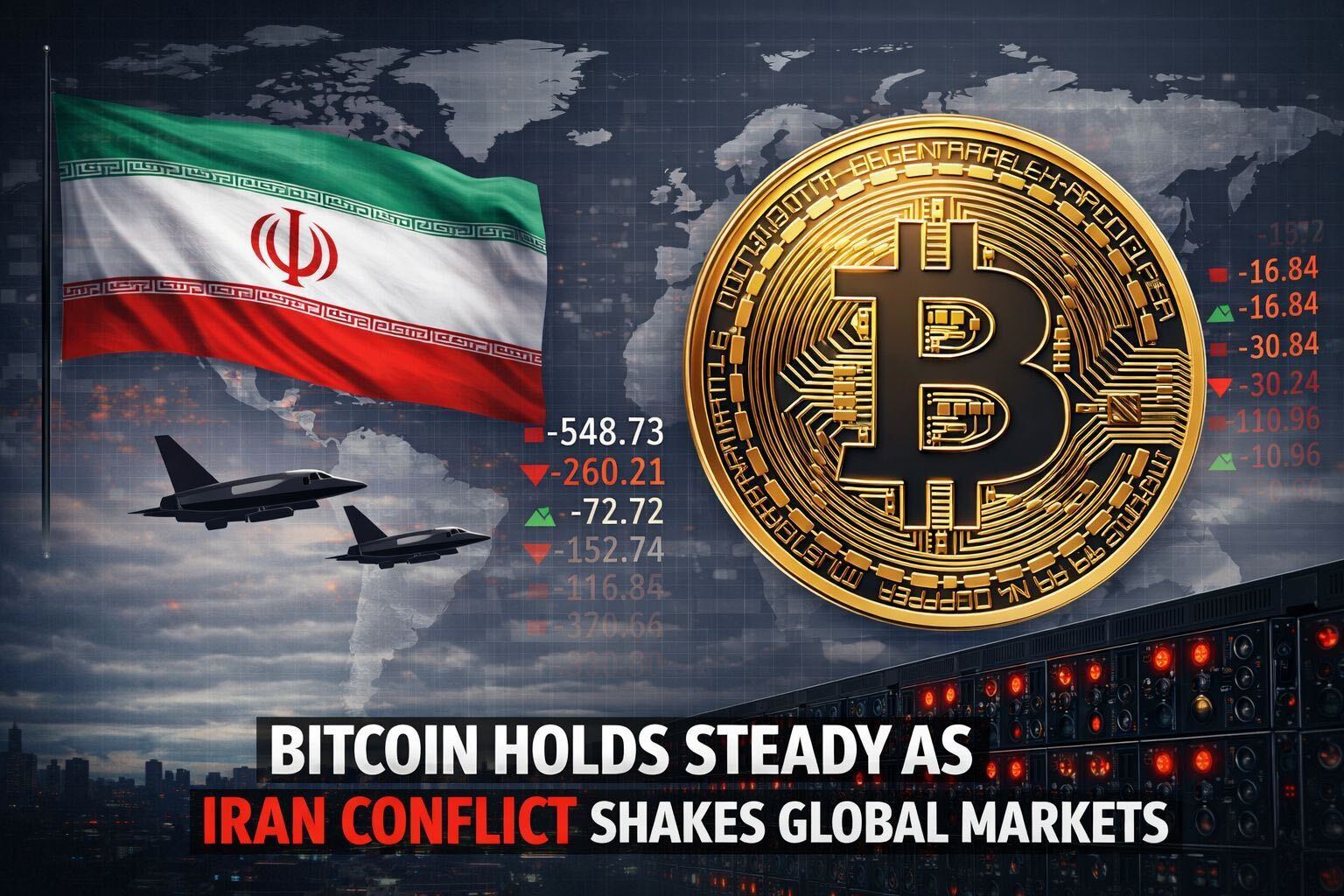
As tensions escalate between Iran, the United States, and Israel, traditional financial markets have reacted sharply. Equities, oil, and bonds have all seen heightened volatility as investors respond to uncertainty.
Bitcoin, however, has taken a different path.
Since the conflict intensified on February 28, 2026, Bitcoin has climbed roughly 10%, reaching around $74,000. At the same time, volatility across traditional markets has surged, highlighting a growing divergence in behavior between crypto and legacy financial systems.
A Clear Divergence Between Bitcoin and Traditional Markets
Market data shows the contrast clearly. Bitcoin’s implied volatility has remained relatively stable, hovering within its normal range despite escalating geopolitical tensions.
Traditional markets tell a very different story.
The VIX, which tracks equity market volatility, jumped from around 20 to above 30 before easing slightly. Oil markets experienced even sharper moves, with the OVX volatility index surging past 100 at its peak. U.S. Treasury volatility, measured by the MOVE index, also climbed significantly, reflecting stress in what is typically considered one of the safest corners of global finance.
This divergence matters.
In previous cycles, Bitcoin often traded like a high-beta risk asset, moving alongside equities during periods of fear. This time, it is not following the same script.
Why Bitcoin Isn’t Reacting Like It Used To
One explanation comes down to positioning.
Bitcoin had already undergone a significant correction prior to the conflict, falling from its October 2025 highs near $126,000 to the low $60,000 range. That reset likely removed excess leverage and speculative froth from the market.
When geopolitical tensions rose, Bitcoin was not overheated. It was relatively neutral.
There are also structural changes at play. Liquidity has improved, derivatives markets are more developed, and participants are more sophisticated than in previous cycles. The result is a market that absorbs shocks differently.
Options data reinforces this. Unlike equities and commodities, where traders rushed to buy downside protection, Bitcoin markets have not shown the same level of panic hedging. That suggests a more measured and balanced outlook among participants.
A Shift Toward an Independent Asset Class
For years, the debate around Bitcoin has centered on what it actually is.
Is it a risk asset? A hedge? Digital gold? A speculative trade?
What this moment suggests is that Bitcoin may be evolving into something more independent. Rather than moving in lockstep with equities or commodities, it is beginning to trade on its own set of dynamics.
This is a meaningful shift.
As adoption increases and market infrastructure matures, Bitcoin’s correlation to traditional assets may continue to weaken. That opens the door for it to play a more defined role in diversified portfolios.
It is not about replacing existing assets. It is about behaving differently when it matters most.
Geopolitical Stress Is the Ultimate Test
The current conflict is not a minor macro event.
Disruptions to Middle Eastern oil infrastructure and tanker routes have introduced real supply shocks into global energy markets. These types of events typically ripple across every major asset class, driving volatility, tightening liquidity, and forcing rapid repricing.
Historically, investors rotate into safe havens during these periods. Gold, U.S. Treasuries, and the U.S. dollar tend to benefit.
Bitcoin holding steady in this environment is notable because it is not behaving like a traditional risk asset, but it is also not yet fully acting like a classic safe haven. It sits somewhere in between.
That positioning is exactly what makes it interesting.
What This Means for Institutional Adoption
Institutional investors care less about narratives and more about behavior.
They are constantly looking for assets that can improve risk-adjusted returns, reduce portfolio volatility, or provide diversification during periods of stress.
If Bitcoin continues to demonstrate resilience while traditional markets struggle, it strengthens its case in all three areas.
Portfolio managers do not need Bitcoin to replace equities or bonds. They need it to behave differently when those assets come under pressure.
This type of market environment is where that thesis gets tested in real time.
Big Picture: Bitcoin Is Evolving, But Not There Yet
It is important not to overstate the shift.
Bitcoin is still a volatile asset. It has not fully earned the status of a safe haven, and one geopolitical event does not redefine its role overnight.
But something is changing.
The combination of steadier volatility, reduced panic behavior, and relative price strength during a global crisis points to a maturing market structure.
Bitcoin is no longer reacting purely as a speculative instrument. It is beginning to show signs of becoming a distinct asset class with its own drivers.
That evolution takes time, but moments like this accelerate the process.
Conclusion
The Iran conflict is acting as a real-world stress test for global markets.
Traditional assets have reacted with sharp volatility and uncertainty. Bitcoin, by contrast, has remained relatively stable and even pushed higher.
That divergence does not just reflect short-term price action. It signals a deeper shift in how Bitcoin behaves under pressure.
It is still early, but the direction is becoming clearer.
Bitcoin is not reacting like it used to—and that may be the most important signal of all.